Hardware and wiring
The voice satellite listens for the wake word, sends the spoken request to Ambrogio and plays the
answer. Its firmware, in the repository
ambrogio-satellite-esp32-s3, runs
today on one board, with an optional round display.
| Part | Role |
|---|---|
| reSpeaker XVF3800 4-mic array, revision 1.1, with a Seeed XIAO ESP32-S3 (8 MB flash, 8 MB PSRAM) | The XVF3800 does the echo cancellation and the beamforming, drives the speaker and the ring of 12 LEDs; the ESP32-S3 runs the wake word and the voice activity detection. |
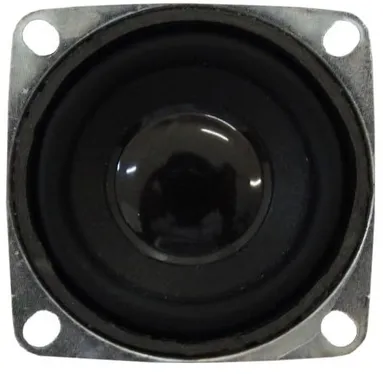
| 2” 4 Ω 5 W speaker | Plays the answers and the music, on the board’s speaker connector. |
| GC9A01 1.28” round display, 240 × 240 pixels, optional | Shows the state of the satellite, the local time at rest and a visualizer while music plays. |
| USB-C cable | Powers the satellite through the board’s USB-C port, the one the case’s stand takes; the XIAO’s own USB-C port carries the flashing and the log. |
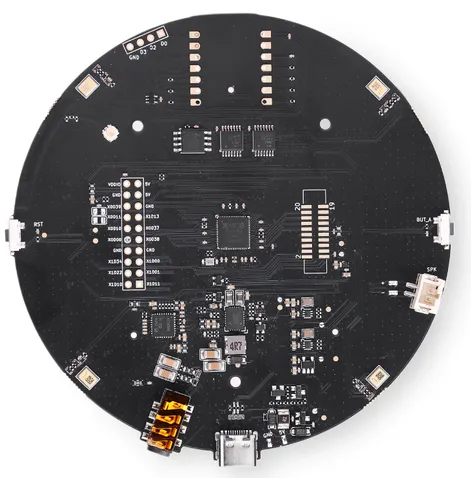
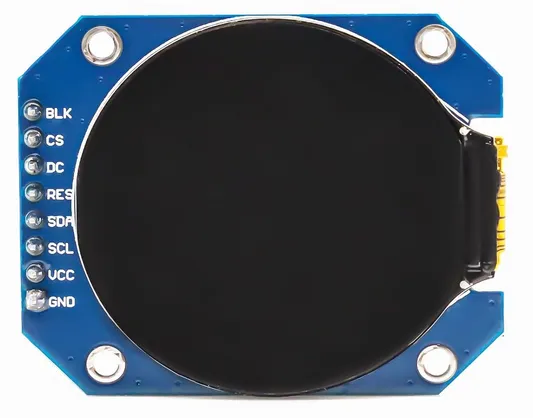
The firmware is built for one board variant at a time: respeaker-xvf3800-v1-1, the board alone,
whose ring of LEDs shows every state of the satellite, and respeaker-xvf3800-v1-1-gc9a01, the
same board with the round display.
Wiring
Section titled “Wiring”reSpeaker XVF3800 4-mic array v1.1||-- 4 microphones, ring of 12 LEDs, XVF3800, TLV320AIC3104 codec|-- SPK, JST PH 2-pin ----------------> speaker, 2" 4 ohm 5 W|-- USB-C of the XMOS, by the 3.5 mm jack: power, XVF3800 firmware|`-- XIAO ESP32-S3, soldered on the board |-- I2C: D4 SDA, D5 SCL ------------> XVF3800 (0x2C), codec (0x18) |-- I2S: D8 LRCLK, D9 BCLK, D6 in, D7 out <-> XVF3800 `-- USB-C of the XIAO: flashing, Wi-Fi setup, logThe round display, when it is fitted, takes six more lines of the XIAO; the schema under The round display states them.
The board
Section titled “The board”The XIAO ESP32-S3 is mounted on the reSpeaker board, and their pins are fixed by the board layout: nothing to wire. The XVF3800 is the I2S master: it drives the clocks.
| XIAO | GPIO | Use |
|---|---|---|
| D4 | GPIO5 | I2C SDA: control of the XVF3800 (address 0x2C) and of the TLV320AIC3104 codec (0x18) |
| D5 | GPIO6 | I2C SCL |
| D8 | GPIO7 | I2S LRCLK, driven by the XVF3800 |
| D9 | GPIO8 | I2S BCLK, driven by the XVF3800 |
| D6 | GPIO43 | I2S data from the XVF3800: the processed microphones |
| D7 | GPIO44 | I2S data to the XVF3800: the playback, which is also the echo-cancellation reference |
| D10 | GPIO9 | I2S MCLK, unused |
The speaker
Section titled “The speaker”The speaker goes to the board’s speaker connector, SPK, a 2-pin JST PH connector on the underside
of the board, the side of the XIAO.
The round display (optional)
Section titled “The round display (optional)”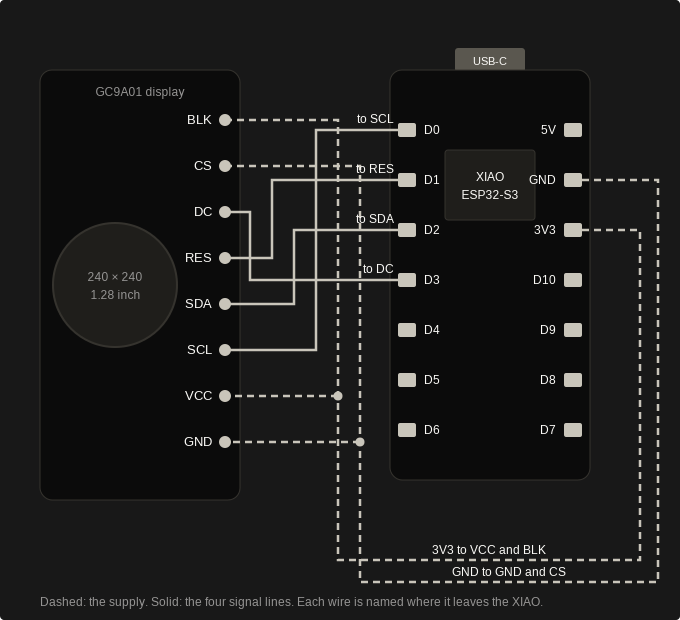
The display takes four signal lines of the XIAO, which do not conflict with the pins above, and its power. Its CS and BLK pins are driven by no GPIO: CS is tied to ground and BLK to 3V3, so the backlight is always on. RES is wired to D1, so that the driver resets the panel at every start, once its supply is stable: with RES tied to 3V3 the panel did not always come out of reset.
| Display pin | Board |
|---|---|
| SCL | D0 (GPIO1), SPI clock |
| SDA | D2 (GPIO3), SPI data |
| DC | D3 (GPIO4) |
| RES | D1 (GPIO2), panel reset |
| GND and CS | GND |
| VCC and BLK | 3V3 of the XIAO |
The board has a 4-hole connector near the XIAO that carries four of these lines, GND, D3, D2 and D0; D1 is not among them and is taken from the pin of the XIAO. In the printed case the wires, about 12 cm of thin wire, are soldered to the display without its header and directly to the XIAO pins D0, D2, D3, D1, GND and 3V3, and run round the top edge of the board.
The XVF3800 firmware
Section titled “The XVF3800 firmware”The XVF3800 needs its I2S master firmware at 48 kHz, written once over the USB-C port of the XMOS, the one next to the 3.5 mm jack: see Flashing and setup.
The case
Section titled “The case”The case is printable and open: the repository
ambrogio-satellite-esp32-s3-case
publishes its model (ambrogio_dome.scad, under the CERN Open Hardware Licence Version 2 –
Permissive), the printable parts in stl/, already oriented for printing, the reference models and
measurements of the parts it holds in components/, and renders of the assembly in render/.
The body stands on its edge like a small round speaker, a flat Ø 130 mm face in front and a half-sphere behind it, on a table foot or a wall bracket. Everything closes by hand, with no glue and no screws: the display bezel locks by turning it, and the face enters the dome with a bayonet. Print the parts in white PETG, 0.4 mm nozzle, 0.2 mm layers, with no support; the face with a brim or on a sticky bed.